Beyoncé Knowles, March 2013
Singer, Beyoncé Knowles is the new cover girl of the March 2013 issue of American Vogue.
In my fashion, her spread in the magazine is a beautiful interpretation of how she has grown into a wise women, and new mother. This issue coincides perfectly with her HBO Special,
Beyoncé: Life is But a Dream, which I thoroughly enjoyed because of the great advice she shares on life and being a strong business woman (plus, her daughter, Blue Ivy, is absolutely
gorgeous).
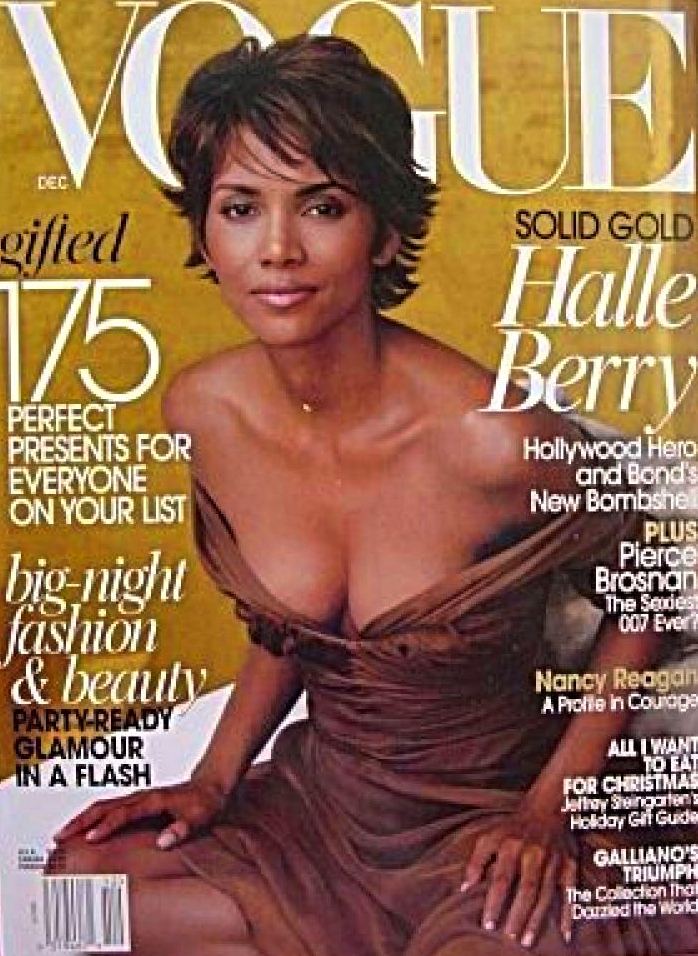
This being her second time, she is among the few black women in history to grace the cover of the coveted magazine, and by my count this cover makes for a total of 29 covers that feature a solo Black women, in all of Vogue’s 120 years of existence.
Oprah Winfrey, October 1988; Halley Berry, December 2002
Liya Kebede, May 2005; Jennifer Hudson, March 2007; LeBron James April 2008
As Tonne Goodman informed us in the HBO Documentary,
In Vogue: The Editor’s Eye, it has been a relatively recent shift from models serving as fashion magazines cover girls, to full bred celebrities gracing the cover of Vogue issue after issue, and we know much about these women (and man) who have been huge figures in the public eye in the last ten years.
In honor of Black History Month, I wanted to take a further look back at the Black women who were on the covers of Vogue, before celebreality changed the way we viewed fashion. From the book
“Skin Deep: Inside the World of Black Fashion Models” by Barbara Summers, I chose to look at the Black women in Vogue’s history that made it to the front of “The Bible of the Fashion Industry” changing the way America, and the world, looked at beauty.
Donyale Luna
British Vogue, March 1966
“In their relentless pursuit of new, the fashion makers of the ‘60s pounced on a creature who transcended Negro, Black, and any of the other racial categorizations, present and past. Her given name: Peggy Anne Donyale Aragonea Pegeon Freeman. Her chosen name—Donyale Luna—was as unusual as her appearance. Gauzed in leopard-spotted silk or sheathed in field flowers on the pages of Harper’s Bazaar in 1965, she was described as having “the tall strength and pride of movement of a Masai warrior.” Time called her a “spindly siren from Detroit…[who] stalked onto the fashion scene and became an overnight success.” Fashion chronicler Bill Cunningham wrote, “The curtain parts, and the white-model dominated fashion world is confronted by the first ethereal African queen image. Her body moves like a panther, her arms, the wings of an exotic bird, the long neck suggests a black trumpet swan. The audience responds with shattering applause….It is the birth of a new fashion era…. The new star on the horizon is Donyale Luna [whose] arrival…was greeted in both the photography and runways worlds of modeling with a success unknown to blacks at that time. She cast a spell of exotic movement over the once-ladylike attitudes…
Famed African American model, Pat Cleveland, said this of Donyale Luna: “Donyale was a poet, a love child, one of those people who really lived in a dream world. She had a child named Dream who lives in Rome. She never wore shoes. Wherever we went she would arrive in her bare feet. She was so beautiful that people would stop eating if they were in a restaurant and they saw her walking by. An entourage of six boys followed her constantly like she was a queen. She always wore dresses with trains, and they would walk behind her and settle around her like she was a princess. She was really the princess of fashion. She was above everything, not of this earth. Then the drug world took her away. She let her real self be seen by me, but she never would come out of that other world. She’s one of the beauties that got trapped in the world of pleasure and passed away.”
Beverly Johnson
August 1974, August 1975, January 1981
…While Naomi Sims had done many precedent-setting covers, she had never been on the cover of Vogue, which was considered more than a victory. For models, it was a consecration. The fact that Naomi had done many splendid inside spreads and had become an international celebrity made it even more difficult to understand why that particular cover eluded her. One could only speculate on the reasons: racial prejudice, her own too-short hair, a to-strong look…Whatever the real determining factors were, Beverly won the trophy cover. And by 1975, she had six Glamour covers, two Vogue covers, the first Black cover of French Elle, and a stunning portfolio of other cover, ads, and editorial tear sheets. Her success also attracted an unexpected amount of flak….
…Market research discovered that White readers of Glamour, even from the South and Midwest, wanted not only to see Beverly Johnson in the magazine, but also to be her in life. She knew her value. She raised her rate to the unprecedented figure of $100/hour when Lauren Hutton, the White star of Revlon’s Ultima campaign, raised hers. Furthermore, she articulated the reason why in the New York Times. She said that an art director “told me I sold a million dollars’ worth of one garment. If you look at it that way, what I’m getting is chicken feed.” Never before had a Black model—and perhaps a model of any color—been so candid about the connection between beauty and big bucks….
…It has been said that the value of our value of our victories is determined by the strength of our opponents. For decades Black models have struggled in non-Black societies like David against Goliath, with no one sling-shot stone delivering an uncontested victory. Beverly Johnson’s first Vogue cover, however, appeared to be our David’s stone. After years of incremental gains, the Goliath of White racism was finally toppled. And we cheered…
Peggy Dillard
August 1977, January 1978
Peggy Dillard was sixteen years old when she moved from Greenfield, South Carolina to New York City to attend Pratt Institute. She had known since age fourteen that she wanted to model after she spent a summer in the city with her brother and his friend, designer Lester Hayatt. She also knew that as much as she wanted to model, she did not want to spend her life being subject to others’ whims. Modeling was not a secure profession. Not that security was her major preoccupation at age sixteen. Her first priority was to complete her education in a field that combined her artistic talents and interests with marketable skills.
“I had to grow up very fast and realize that accountants and agents and all these people aren’t always the nice people that they seem to be. You realize that you’re a major commodity and that you’re supporting more people than you know in more ways than you know. Models make a lot of money, but people never look at our expense side. To make a lot of money, you must spend money. And as I really started paying attention, I realized that the reason some Girls didn’t work as much was because they didn’t take good care of themselves. I was very religious about all that.
“Sometimes I call the American way of life the unconscious way of life, the unconscious existence, because of the combinations of things we put into our bodies without thinking about the actual chemistry. You have to sit down and evaluate your environment, your diet, and your lifestyle. And if you don’t do this at some point, you’re not growing wiser, you’re just growing older. You’re killing yourself, and you’re not really learning from your mistakes. You have to know what you want in life, not just in terms of a modeling career, but your overall life, and then put modeling into perspective. If it becomes your whole life, then you’re going to have problems, because as a model you’re a commodity, and your life can go up and down with your career.”
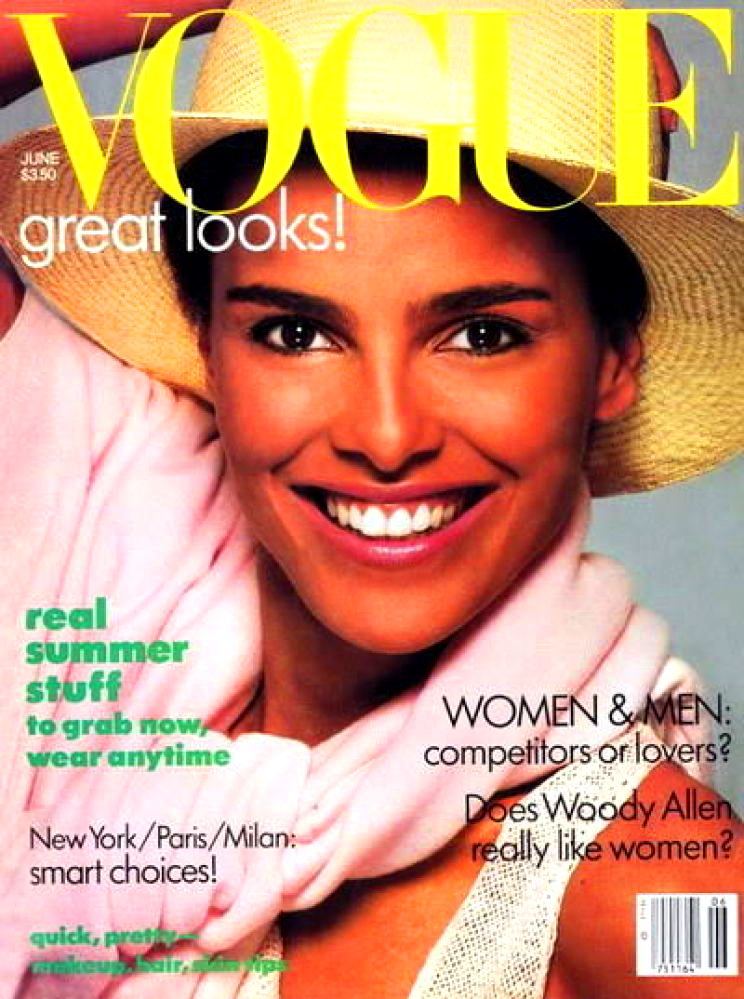
Shiela Johnson
March 1980
Shelia had wanted to be an actress before she became a model. When she won a highly visible part in Eddie Murphy’s film, ‘Coming to America’, she was even more determined to pursue her old dream…”My acting teacher did something I really resented, and she did it because she saw something in me that I had not confronted. She said, ‘No Black people have ever graduated from this school. They always cop out. They don’t have the confidence level. You've got to get in touch with your Black anger. There’s so much anger and rage there.’ I thought, Why? Why did that have to be? It made me so angry. But it was cool. She saw that in me the recognition of something that might not have been a part of my life. Making me question all this stuff in my head was the most fabulous thing.”
Journalist Carol Mongo observed the scene in Paris. “Back in ’82, I was doing a story on the modeling profession. There was one Girl in Givenchy’s cabine who was dealer. Everybody knew that. But, of course, when I went to Givenchy, they adamantly denied it. However, we all knew who the Girl was, by name and by face. When I did the research for that story, it was not only Black Girls, but White Girls as well doing drugs. If the first show started at ten-thirty a.m. there would be some models who were clearly drugged out already. The French looked at it as something brought in by Americans."
One of the stars who acknowledged the pressure and refused to succumb was Sheila Johnson. She cited an explosive magazine article published in the ‘80s where her agent implied “that he would rather have the model who stayed out all night and got drunk and got a reputation for being late for work because that gave her stress and pizazz and sex appeal. I didn't want to be connected with the agency, that’s how profoundly disgusted I was. That’s not what I’m all about.” Although her agent later sent a letter of apology to his Girls, Shelia thought “this was a perfect exit moment. That’s when I started auditioning and got ‘Coming to America'.”
Shari Belafonte
February 1984, December 1982
January 1985, May 1985, June 1986
Is there life after modeling? To those on the outside looking back, the answer was an emphatic yes. To those on the inside still looking around, the answer was not so clear.What other work could provide the lights, attention, glamour, and money? How could a model leave all this behind? The truth was that the model most often did not leave the work. Instead, the work left her.
Staring that fact in the face was one of the most difficult tasks of a model's career. Throughout she had to cope with the seasonal changes of catalog bookings and designer collections. She dealt with fluctuating trends in trivia - hair style and brow shape - that could mean the difference of thousands or even hundreds of thousands of dollars. She confronted the daily unpredictability of bookings, income, competition, and status with a sense of persistence and panache. She disagreed with agents who wanted to use her more - or less - than was good for her overall exposure. After facing down so many challenges - which created its own kind of routine - many a model found it difficult to accept that work was no longer slow, but simply over. The attachment to modeling was not only to a paycheck or to a profession but to a sense of self-worth...Although only a few hundred women per decade - and even fewer Black women - truly succeeded as models, billions of women succeeded daily in less exalted roles as human beings. Models desired to be both exceptional and ordinary, to achieve in a tiny, exclusive world as well as to flourish in the largest one. Recreating themselves as real people was their greatest challenge.
Celebrity daughter to singer, Harry Belafonte, developed her own charm and appeal as a model. She was a popular Cover Girl model she had a multifaceted career, appearing on several seasons in the series ‘Hotel’, and tried to launch a product line of make-up.
Louise Vyent
February 1987
Professional chameleons, models could change almost everything about themselves about themselves except their skin color. Although photographic lighting and processing techniques, such as airbrushing and retouching, could indeed change skin color - always to lighten darker eyes and complexions - many Black models were more concerned with changing the meaning of color, rather than color itself. They wanted to discard the tired notion that dark brown skin connotated danger, fear, and poverty, and , at the same time, sexual power and primitive authenticity. They wanted to dispel as well the antiquated conceit that lighter brown skin signified safety, success, and intelligence, but also instability and aspirations to be - or, at least, pass for - White. Whatever their philosophical intentions, however, models did not make the casting decisions. When it came to decide who would wear what outfit in a show, a shot or a commercial, designers, editors, and ad execs had final say. Those were simply the rules of the game. And rare was the conscience that could afford to reject a paycheck.
...One model-turned-actress, described a situation satirized by Robert Townsend's hilariously on-target film, Hollywood Shuffle. It could be sub-titled "How White People Define Blackness." Connie Fredericks said, "I walked into a commercial casting session where they wanted a nurse or somebody like that. I wore a string of pearls, a soft blouse, and a jacket and skirt. The casting director said, and I've been told this many times, 'Look, this is a mama. She's got three kids. She's a single parent. We want you to get away from the pearls. We want you to get down, honey.' When we were looking for that clean, basic, here-I-am personality, America is still filtering that personality through their perception of what a Black person is supposed to be.
Of Dutch and Surinamese parentage, Louise Vyent brought a fresh spin to the international identity of Black print Girls.
Kara Young
April 1988, October 1989
The sirens crooned, If you make it in modeling, you'll be loved not just by the adoring masses but also by the one person you’ve been longing for. You’re up there on the runway; can’t he see you? You’re out there on the billboards; wont he find you? You’ve got looks, you’ve got a career, you’ve got money. All that remained to get was love. Surely he would come along and complete this most perfect picture.
If Sleeping Beauty woke up to a Prince, many thought that models should, too. Expectations ran high. No woman - especially a rich and beautiful one - deserved to be loveless and alone. On the contrary, one of the classic rewards for exceptional beauty was deemed to be an equally exceptional love. For every model, there should be a rock star, an actor, a director, a millionaire, a hero. Or maybe just an ordinary nice guy. Somebody.
Because models were most often seen as images and not known as people, few knew what happened to the them when the spotlight went off, the cameras were put away and everyone went home. Dorothea Towles and Sara Lou Harris were two women who found happiness in successful partnership, as did Helen Williams, Carol LaBrie, Sandi Bass, Peggy Dillard, and Pat Cleveland, among others. But many, if not most, models were not so lucky. Or whatever that elusive quality was. Their beauty exerted a contradictory force. As it seduced, it intimidated. As it attracted, it also repelled.
Warren Jackson had to change his opinion of models once he "got to know all the Girls in Milan...In Italy, in particular, the Black Girls have a terrible image. Black women are seen as sex objects. The things I heard men say in the audience. They’re just sitting there, dying, waiting for the low cut blazer to open up so they could see something. And it burned me up. I didn’t like to see my people treated like this. Every last one of these Girls deserved everything she got. They worked hard, and their work was beautiful."
Black models rarely appeared on the cover of bridal magazines, but Kara Young was one of those exceptions in the portrayal of a beautiful bride to be.
Karen Alexander
January 1989
Karen's motivation for going into the modeling profession seems as far removed as possible from outsiders notion of youth, beauty, and, oversized ego. "I've always loved older people," she says. "All my grandparents died when I was very young. So I thought, Why don't I work in a nursing home? I can be around all the older people that I'd like." While working in an institution in New Jersey where she was raised, she dreamed of what she could do with the money earned from modeling. But all the agencies she went to in New York said no to signing her.
"I take my job very seriously. If Vogue chooses me over a million Girls - Black, White or green - and they decide that they want Karen Alexander for ten pages, I feel a lot of pressure. I mean, I know that I'm not a brain surgeon. When I do a catalog, I take that seriously as well. There are a lot of other models in the world. The thing that I love most, my best compliment, is a good catalog client or an art director who'll say to me, 'Hey, we know this piece is a dog, but Karen, we know you can sell it.' What else does a model want to hear?
Karen Alexander is one of the few top Girls in her generation to be a mother. "The shows came around when I was four months pregnant. I worked a lot, and I felt beautiful and strong. I sailed through Paris, but when I showed up in New York, I'd had enough. I was pleased with my career, and I just wanted to stop. I felt that motherhood would be my next thing and that I would retire."
But the fashion industry was not ready for her to quit…
Although Karen's favorite magazine story was a Vogue spread with photos of her with her daughter, Ella, and an article on her family, Karen has decided not to do any more pictures with her daughter. "I think that it's an invasion of her privacy. She's not an accessory. She's not a handbag. When she's old enough and she'd like to be a model and be in a picture with me, I'd be more than happy. But I don’t feel that because she's my child, she’s my possession. I have a lot of respect for her. I don’t feel that it's my right to subject her to that.
Naomi Campbell
September 1989, June 1993
In the pose of a guileless ingénue, she admitted that when she stated she “didn’t really know how to move like a model. I was just dancing around with the photographer Bill King,” who booked her to shoot the Saint Laurent couture collection in Paris for French Vogue. Ads for Saint Laurent perfumes and clothes soon followed, as well as a resident apprenticeship chez Azzedine Alaïa. Trained in dance and drama, she loved to perform, and it showed in the expressiveness of her work. At the age of nineteen she became the first Black model to appear on the cover of American and French Vogue simultaneously.
The secret of her longevity was ironically, visible to all. Relentlessly, competitively fashionable, she reveled in contrasts. She was the acknowledged champion of reinvention in a business whose short-term vocabulary consisted of two words: new and next. What showed even more than the quantity of her work was its quality; the unexpected variety, spontaneity, and sheer fun of her many looks. Without any complicated, race based apology, she seemed to change hair styles by the hour. She wore long, straight weaves, short flippy wigs, blond streaks, red streaks, and an attitude that declared, Accept me all the ways I am. She even wore blue and hazel contact lenses, shocking people with her untroubled ease in breaking convention. Perhaps her generation—she was born in 1970—had something to do with the freedom she insisted on. Perhaps the mix of African, European, and Asian in her Jamaican family was a factor. Perhaps overcoming childhood inferiorities influenced her also.
Naomi respected the lineage of great models who preceded her and was determined to leave her own legacy. “When I look at Iman and Beverly Johnson and Naomi Sims and Peggy Dillard, and all the others, I appreciate the fact that they opened the door for me. If they had not come before, I would never be as far along as I am now. And I hope that I’m opening the door for people who’re behind me. It’s gotten better. It’s getting better. People take note of what you’ve done and give you that courage to go on. You have to show that we have the quality, too, that we can be out there as much as the White model can. And you have to let Black people see that, because a lot of them think it’s impossible.”
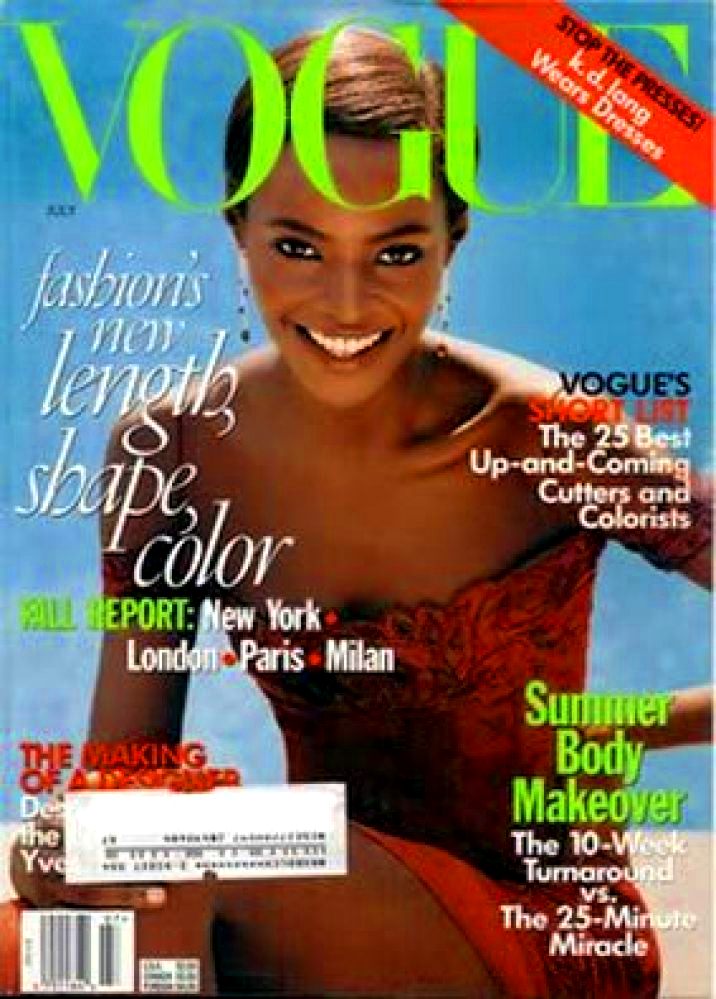
Kiara Kabukuru
July 1997
It is part of the curious language of a curious profession that women who model are called girls. Their chronological age does not matter, nor their life experience, hourly income or celebrity wattage in the media. In the business everyone refers to models as girl - including the models themselves.
Except in this book. In Skin Deep, all models are Girls with a capital G. Slightly adjusting the posture of this one word elevates these women above the belittle term which infantilizes them and insults their profession, all with the sweetest intentions.
Beauty is a power. Women know this. Black women in White societies, especially, know this. And Black people, so often misnamed and misjudged on appearance alone, know from personal experience that there must be more to Black models that meets the eye. They are right.
Simply because models are in the business of projecting their face and figure, none of us should be deluded into thinking that what we see is all they've got. Or that what we call them is all they are.
Michelle Obama, March 2009; Beyoncé Knowles, April 2009; Halley Berry, September 2010
Rihanna, April 2011 and November 2012
It is a sign of their success that Black models are taken for granted today. At the end of the 20th century, these models stand tall because they are supported by the many women who proceed them women of color who were pioneers in a special wilderness, the profession of fashion and beauty. Since the middle of this century, every generation has had its pathfinders and trailblazers, its novas and shooting stars, extraordinary women who shone with a special light. We have seen them, often admired and even idolized them, but rarely have we known them, and never have we examined their history.