Sunday, June 9, 2013

Style Maven: Diana Vreeland and the Met (Part 4)

Diana Vreeland
As I said in Part 1 of this Style Maven series featuring Diana Vreeland, my quest on #IMFblog has been to examine where trends and social behavior originated as it pertains to fashion and style. I aim to find what fashion was, and what we are turning it into day by day going forward. Diana Vreeland having served as Vogue’s Editor-in-Chief at a time when fashion became a powerful tool of expression for women helped her to convey to America a concept of beauty that was aspirational and liberating for all women to follow. Diana Vreeland’s aura is still riddled in the excitement associated with the fashion industry, and the way that we think about fashion is a product of the mind of this visionary figure. That is why this month and next month I choose to delve into her work at the Costume Institute which is another arena of fashion where she brought her inimitable influence setting a standard that we still aim to achieve not just for fashion, but in the field of costume curating. I want to examine what we can learn from DV about style and fashion through her curatorial work. I figure, in light of this year’s exhibition opening, doing so will give us an eye into the difficulty of producing an exhibition, and Vreeland’s thoughts on how to create drama in presentation. In my fashion, one who has style has a recognizable character, and those who understand the character they play in life have the power to produce a life’s story that teaches others what it means to live a fulfilling life. (Photos and text come from the following books: ‘The Empress of Fashion’ by Amanda Mackenzie Stuart, ‘Diana Vreeland: The Eye has to Travel’ by Lisa Immordino Vreeland, and ‘Diana Vreeland’ by Eleanor Dwight)

Romantic and Glamourous
Hollywood Design
Exhibition Catalog
Romantic and Glamourous Hollywood Design Exhibition (1975): Once Hoving came around to the idea, Diana went to Los Angeles and embarked on a major search, assisted by costume designer, Robert La Vine. This time, the chief difficulty she encountered was Hollywood’s lack of respect for its own past. Costumes were cut up and reused, and many studios did not keep or catalog them. The people who preserved Hollywood costumes were all too often obsessive private collectors who refused to let Diana over the doorstep, let alone borrow the clothes.

She eventually broke through. Paramount and Warner Brothers had kept their more significant items. The Family of David O. Selznick had preserved the costumes of “Gone With the Wind”. Mary Pickford had somehow managed to hold on to the costumes from all her films and allowed Diana to explore the attic of her house... Mary Pickford had not been quite so successful in hanging on to her curls, which Diana found in the Los Angeles County Museum of Natural History, along with Mae Murray's costume from "The Merry Widow". She was stunned by the the quality of the workmanship. Carmel Snow (Ex-Editor-in-Chief of Harper's Bazzar) and Diana had given the designer Adrian very little support when he moved hrom Hollywood to Seventh Avenue, but Diana raved about him as a costume designer, along with Travis Banton, Wlater Plinkett, and a host of less known names. "The basis was perfect designing and incredible workmanship - the cut of décolletage, the embroidery, the mounting of a skirt, and miles and miles of bugle beads," she wrote. In Diana's view the best Hollywood costumes were as good as anything produced by the couture.

As Eleanor Lambert found out, Diana's method in putting together the Hollywood
show perfectly articulated the essence of an industry that "created a world that never was, that opened a new universe for millions....No woman ever crossed the desert in those chiffons Marlene Dietrich wore in
"The Garden of Allah - but what a way to dream of crossing the desert!"

On her travels around Hollywood Diana met a fanatical collector of movie stills. He allowed her to search through thousands of images until she found costumes she remembered from her youth that had disappeared from view. This resulted in one of the most controversial aspects of the exhibition - Diana'a audacity in commissioning replicas when she was unable to find the original, or where the piece in question was too damaged to have any impact.


Designers who helped with replicas of Hollywood costumes for the exhibition included Oscar de la Renta, Bill Blass, Arnold Scaasi, Giorgio di Sant'Angelo, and Stan Herman. They were fully acknowledged, and every copy was faithfully spelled out in the accompanying catalog (above). But there was a feeling in the curatorial world that it was not done to mix up replicas with originals in this way; that when it came to the point of the difference was not made sufficiently clear; and that it was somehow misleading for uninformed visitors who might not bother to read the small print.


The uniformed visitors did not seem to mind one bit, as they lost themselves in a shimmering world of tinsel and marquee lights. They found Marilyn Monroe on an elephant loaned by Andy Warhol. They saw her skirt catching the breeze in "The Seven Year Itch". They encountered Grace Kelly, Cary Grant, and Gretta Garbo. They gazed at Audrey Hepburn in "My Fair Lady" with it through galleries scented with "Femme" by Parfumes Rochas to soundtracks from "Top Hat to Dr. Zhivago". Judy Garland sang "Get Happy." "That's the best advice anyone can have ," Diana on the audio guide. Movies were the big trip of the twentieth century and put magic in our lives." They took people to worlds of which they could only dream. "It is about the dreams, the grandeur of Hollywood. It 's Travis Banton taking you across the Sahara in flowing chiffon. It's Queen Christina dressed historically, romantically, the way you'd prefer history to be. That's the idea of Hollywood. Do it Big. Do it Right. Give it Class."

Since Diana herself had a rich imaginative life, she was convinced that American moviegoers did as well. When they went into the dark theaters, they became the characters in the celluloid stories...According to Vreeland, extending fantasies and horizons beyond our wildest dreams was important to Americans, "who could not make it out of their small towns, off the back porch in Kansas."

Friday, June 7, 2013

Bit-O-Inspiro 37


"Gianni Versace is his own man. He is not afraid to change. Dreary and safe are not words in his vocabulary. Gianni innovates while others wallow in their beige world." - 'Rock and Royalty: The ever-changing look of Versace's couture, as seen—and modeled—by the kings, queens, mega-models, and jokers of rock & roll'

Wednesday, June 5, 2013

Style Maven: Diana Vreeland and the Met (Part 3)

Diana Vreeland
As I said in Part 1 of this Style Maven series featuring Diana Vreeland, my quest on #IMFblog has been to examine where trends and social behavior originated as it pertains to fashion and style. I aim to find what fashion was, and what we are turning it into day by day going forward. Diana Vreeland having served as Vogue’s Editor-in-Chief at a time when fashion became a powerful tool of expression for women helped her to convey to America a concept of beauty that was aspirational and liberating for all women to follow. Diana Vreeland’s aura is still riddled in the excitement associated with the fashion industry, and the way that we think about fashion is a product of the mind of this visionary figure. That is why this month and next month I choose to delve into her work at the Costume Institute which is another arena of fashion where she brought her inimitable influence setting a standard that we still aim to achieve not just for fashion, but in the field of costume curating. I want to examine what we can learn from DV about style and fashion through her curatorial work. I figure, in light of this year’s exhibition opening, doing so will give us an eye into the difficulty of producing an exhibition, and Vreeland’s thoughts on how to create drama in presentation. In my fashion, one who has style has a recognizable character, and those who understand the character they play in life have the power to produce a life’s story that teaches others what it means to live a fulfilling life. (Photos and text come from the following books: ‘The Empress of Fashion’ by Amanda Mackenzie Stuart, ‘Diana Vreeland: The Eye has to Travel’ by Lisa Immordino Vreeland, and ‘Diana Vreeland’ by Eleanor Dwight)

The Tens, Twenties,
and Thirties: Inventive
Clothes 1909-1939
Exhibition Catalog 
The Tens, Twenties, and Thirties: Inventive Clothes 1909-1939 Exhibition (1974): The exhibition was called The Tens, Twenties, and Thirties: Inventive Clothes 1909-1939. The real stars of the show were the clothes themselves, chosen by Diana not just for their beauty but for the extent to which they exemplified new ideas: the new freedoms heralded by Poiret; the simple relaxed suits of Chanel, and her embrace of male fashion for the lives of modern women; the craftsmanship and inventiveness of Vionnet, the first to cut fabric on the bias so that it moved with the female body; the wit, artistry, and surrealism of Schiaparelli; the romantic fantasies in lace of the Callot Soeurs; and the Orientalism and the colors of the Fauves and Ballet Russes. Each design represented experiments in length and line that would play themselves out over and over again throughout the twentieth century. There were pieces in the exhibition that Diana remembered well from Europe in the 1930s, lent by other collections at the urging of donors such as Mona Bismarck and Millicent Rogers. Once again Diana called for assistance from every direction, and battled to ensure that each exhibit was beautifully staged and lit. Exhibition visitors wandered through the galleries to the strains of Gershwin, Eric Satie, Stravinsky, and Duke Ellington. Chanel perfume was sprayed in the galleries twice a day. Contemporary paintings, by Guy Pène du Bois and Kees van Dongen among others, helped set the scene.

The importance of this second exhibition was that it showed the clothes that had inaugurated the line of the century, clothes of fantastic workmanship and style interpreted by someone who had worn them herself. 

This time, the reaction was unequivocal. The press called it a “dazzler,” and the designers were enthralled. Apart from remarking that it was the best costume exhibition he had ever seen, Bill Blass was convinced it would have “the most shattering effect on fashion.” 


Valentino, who was closer to French couture than most of those present, was stunned by the Vionnet dresses at close range. The show had such an impact on Issey Miyake that he arranged for it to go to Japan, believing that it would open the eyes of Japanese designers. 

This fashion revolution had liberated women, changed what they wore, how they wore, how they looked and how they felt about themselves. For centuries women had been corseted and covered with long skirts, their legs completely hidden. As Vreeland put it before this time a woman "was a confection of leg-o-bustles into which a body had been squeezed, with a head attached. The dress entered the room, not the woman."

Harold Kota and Richard Martin later wrote: "The foremost accomplishments of Halston in the mid- and late- 1970s seem so clearly predicated on his interpretative engagement with this show." The exhibition was credited with introducing a new generation of New York's designers to the possibilities of the bias cut; and it revealed Diana as a connoisseur as well as  catalyst of fashion. 


It also inspired Irving Penn to shoot a photographic essay (examples shown above): he greatly preferred photographing clothes on uncomplaining Schlappi mannequins to working with temperamental models. The exhibition and and its staging caught the imagination of the public too. 

Actress and interior designer, Elise de Wolfe, was one of Diana's idols, who was more appreciated
for her costumes than her acting in the early 1900s. Above she wears her Schiaparelli cape with Jean Cocteau's design
before she gave it to the Costume Institute.

The Balenciaga show had been a commercial success, with more than 150,000 visitors. This one broke records. Almost 400,000 people went through the galleries, vindicating Diana's perspective, her showmanship, and her taste, and ensuring that there was no further question about her position at the Met.  

Monday, June 3, 2013

Style Maven: Diana Vreeland and the Met (Part 2)

Diana Vreeland
As I said in Part 1 of this Style Maven series featuring Diana Vreeland, my quest on #IMFblog has been to examine where trends and social behavior originated as it pertains to fashion and style. I aim to find what fashion was, and what we are turning it into day by day going forward. Diana Vreeland having served as Vogue’s Editor-in-Chief at a time when fashion became a powerful tool of expression for women helped her to convey to America a concept of beauty that was aspirational and liberating for all women to follow. Diana Vreeland’s aura is still riddled in the excitement associated with the fashion industry, and the way that we think about fashion is a product of the mind of this visionary figure. That is why this month and next month I choose to delve into her work at the Costume Institute which is another arena of fashion where she brought her inimitable influence setting a standard that we still aim to achieve not just for fashion, but in the field of costume curating. I want to examine what we can learn from DV about style and fashion through her curatorial work. I figure, in light of this year’s exhibition opening, doing so will give us an eye into the difficulty of producing an exhibition, and Vreeland’s thoughts on how to create drama in presentation. In my fashion, one who has style has a recognizable character, and those who understand the character they play in life have the power to produce a life’s story that teaches others what it means to live a fulfilling life. (Photos and text come from the following books: ‘The Empress of Fashion’ by Amanda Mackenzie Stuart, ‘Diana Vreeland: The Eye has to Travel’ by Lisa Immordino Vreeland, and ‘Diana Vreeland’ by Eleanor Dwight) 

The World of Balenciaga
Exhibition Catalogue
The World of Balenciaga Exhibition (1973): Spanish couturier, Balenciaga, had died on March 23, 1972…After her split from Vogue, curating exhibitions was a great change from Vogue, where Diana had only to pick up the phone to get what she wanted…it had started to look as if she failed her very first test for there was no one on hand to advise her and she had to feel her way…What proved unexpectedly hard, however, was the task that should have been the easiest: persuading friends in Europe who owned Balenciagas to loan them to the Metropolitan Museum…It soon turned out that locating the right sort of Balenciaga from the important moments in his career was only half the battle with Diana only having 6 months till the exhibition opening since having secured her position…As she went through that process for the first time, Diana discovered an enormous amount of unexpected and invisible work, not to mention an aptitude for hustling. She had to talk many people into providing everything for nothing. She and her secretary handled a multitude of details, from clearing permissions, checking the spelling of names, keeping in touch with every donor to the exhibition in the United States and Europe, acknowledging the clothes as they arrived, and finding the right accessories for every outfit not to mention editing, mounting, and grouping the displays.

"After Diana's death in 1989, the Met's director, Philippe de Montebello, claimed that "until the spring of 1973, it could be said that the field of costume had been a sleepy and rarefied one...An aura of antiquarianism seemed to enshroud every costume display, and they had, for all intents and purposes, no audience beyond a few specialists." Then Diana Vreeland appeared at the Costume Institute and an entire field was transformed, with "an uncanny sense for drama and style."
Diana often saw what people thought of as street fashion for the first time in Balenciaga…In the center of the Balenciaga show was "the armour of Charles I on a huge white horse - flamenco music plays faintly and one hears heels and castanets clicking." The designer's perfume enveloped the galleries, which were painted in the master's favorite colors - acid green, magenta and Spanish yellow...To make the exhibit arresting enough to Diana’s standards, Diana hated the Costume Institute's mannequins, maintaining that they were too lifelike, gave her the creeps, and make the museum's costume exhibitions look like a display in Saks. She battled to use mannequins made by the Swiss manufacturer Schlappi, which were taller than the average person, were produced in different finished, and had an abstract quality about them that Diana greatly preferred. Furthermore, she insisted they be as close to the visitors as possible, and behind glass, and should be grouped together above head height for maximum drama. 


The Balenciaga exhibition attracted more than 150,000 visitors and showed just how capable she was; and she had also made a case that benefited them all, for the courtier as artist…In this same year, the Council of Fashion Designers of America (CFDA) became a benefactor of the Costume Institute, and the ‘Party of the Year’ changed with the focus of its attendees turning towards circles where fashion and high society intersected…This was a most welcome development, not just because the ‘Party of the Year’ brought glamour, and social distinction, but because the strategy was such a success that revenue from par

Saturday, June 1, 2013

EDITOR'S LETTER: June 2013

Finally! Consistently WARM weather, at last! In my fashion, after this past Memorial Day, I would say summer has arrived. This past month, there were still days of which I felt it was still a little chilly for one to enjoy the outdoors, but if this past week was any indication, from here on out I think its safe to say that we will soon be lamenting the scorching waves of the sun, itching for cooler weather again to relieve us of suffering from visible sweat stains; but, I digress.

In my fashion, life is a play with no rehearsal. 
I for one will be one person who will make an effort not to complain about the pending hot weather, because in my fashion, I was thoroughly over having to wear more than one layer of clothing before I left the house. Now that summer is a coming, this is the time of year we can literally wake up, throw on a light shirt, some shorts, and your most striking shoes and look fabulous everyday. I personally love going outdoors, and winter makes it so hard for one to do so. I love the green from the trees that offset the beautiful baby blue sky, and pillowy clouds. I adore seeing people enjoying life, and expressing it through their clothes. People are much more bright and inventive with their clothes, and the feel of summer invites all sort of activities where we can play with fashion. 

Four different attitudes, One look: 1) Optimistic 2) Smooth 3) Menacing 4) Haughty 
Keeping with last month's theme, Fashion is Theater, we will continue to explore how to project that innate character that we are to play in life. In my fashion, as Janelle Monae said in her new single, Q.U.E.E.N., "Life is a play with no rehearsal." Today, with social media, we are all documenting our lives, and putting on a show for the internet community. Summer is the perfect time to get outside, take photos, and show off how one enjoys life through your clothes! My love, Dwight (@KenDutchess), always harps on my low social media interaction, and that I can do better to beef up my Instagram interactions and photos, so this month I am going to take his advise, and increase my presence on Twitter, Instagram, and Tumblr. Get ready to see more innovative outfits from myself, and voyeristically experience fashion through #IMFblog, a vision for the future of fashion! Anything that I can do to bring attention to the world of fashion, and change perspectives on what we classify as beauty is the my goal for my social media platforms, so this month I will be itching to hear more from my friends, family, and audience as I present fashion's most singular pieces, looks, historical facts, and sartorial experiences. Just like Vogue's International Editor-at-large, Hamish Bowels says in his series, 'Vintage Bowles', one must be most inventive in their strategy of how to find things, and the 'fashion hunt' is what #IMFblog is all about!

In my fashion, style determines the  character one plays in life. Playing your role well, starts with the look. 

As you know, from my previous Style Maven post, Diana Vreeland is the focus of the theme, Fashion is Theater. A few days ago, I introduced Ms. Vreeland, and all this month I intend on elaborating on her individual Met Gala exhibitions when she served as the Costume Institute's Special Consultant. I was actually shocked when I was doing my research on her to find that there is very little information on the internet regarding specifics about Vreeland's exhibitions, so hopefully the following Style Maven series this month, will educate one about the fantastic vision that Vreeland brought to fashion, and how she emphasized drama is fashion, for drama is entertainment and is what makes fashion most fun and intriguing for all of us.

Friday, May 31, 2013

Bit-O-Inspiro 36


In my fashion this fashion book, 'Rock and Royalty: The ever-changing look of Versace's couture, as seen—and modeled—by the kings, queens, mega-models, and jokers of rock & roll' is too inspiring. Then photos of Kristen McMenamy are my favorite! This book was published in 1997, so its a great walk down memory lane of the 90's. 

Wednesday, May 29, 2013

Style Maven: Diana Vreeland and the Met (Part 1)

On May 6, 2013, we all know that was the night of the Metropolitan Museum of Art’s Costume Institute’s ‘Party of the Year’. In celebration of this year’s exhibition opening of Punk: From Chaos to Couture (on display til August 13th), I tuned into Vogue Magazine’s live stream of the event’s red carpet, and in my fashion, the feel of the night had a very ‘20s glam’ vibe to it as I was taken aback by languid, dresses paired with daring accessories (probably very much influenced by this year’s release of The Great Gatsby, and Vogue’s May 2013 issue featuring lead female of the film, Carey Mulligan). At the gala, I loved her sleek black dress and the classic 20s heels, but as always at #IMFblog, I was most impressed by those who go against the grain! Watching the beginning of the night’s festivities unfold with an enchanting looking Hilary Rhoda wearing Wes Gordon as co-host to Vogue’s, William Norwich, the names to look for, in my fashion, were: Kimberly Chandler (6:10),   Lauren Santo Domingo (10:20), Miley Cirus (28:17 and 31:14), Sara Jessica Parker (51:12), Cameron Diaz (59:57), Kristen Stewart (1:02:24), Katy Perry (1:05:07), Alexis Welch (1:11:06), wife of Amar'e Stoudemire, Anne Hathaway (55:03), Andrew Baven (1:17:18) who arrived with Hailee Steinfeld, Jennifer Lopez (1:19:51). These were the stars of which I felt fabulous enough to have been inspired enough to add to my list of ‘Grand Style of the Night’ especially in coherence with the theme of the night, Punk. Reviewing photos of the event, I feel Kate Beckinsale never looked better, and my personal favorite of the night was, Nicole Richie. Try to catch the above celebrities' looks in the live stream below: 


If you recall from my last post, READing Your Style: Vogue Fashions (Part 2), Punk had “a social significance”, as Marc Jacobs (55:43) said when interviewed at the Gala. Andrew Bolton (46:20), curator of the exhibit said, “Punk has an integrity and authenticity that continues to engage people now,” and it is as model, Karen Elson (24:32), said it is, “ultimately what society is ultimately supposed to be.” Elson’s comment struck a chord with me because, in a sense, there is a bit a truth to that statement. Punk helped form our modern views on style for it made uniformity redundant, showing that style is about individuality, not conformity. Jonathan Van Meter looked back on Punk’s origins in Vogue’s May 2013 issue:

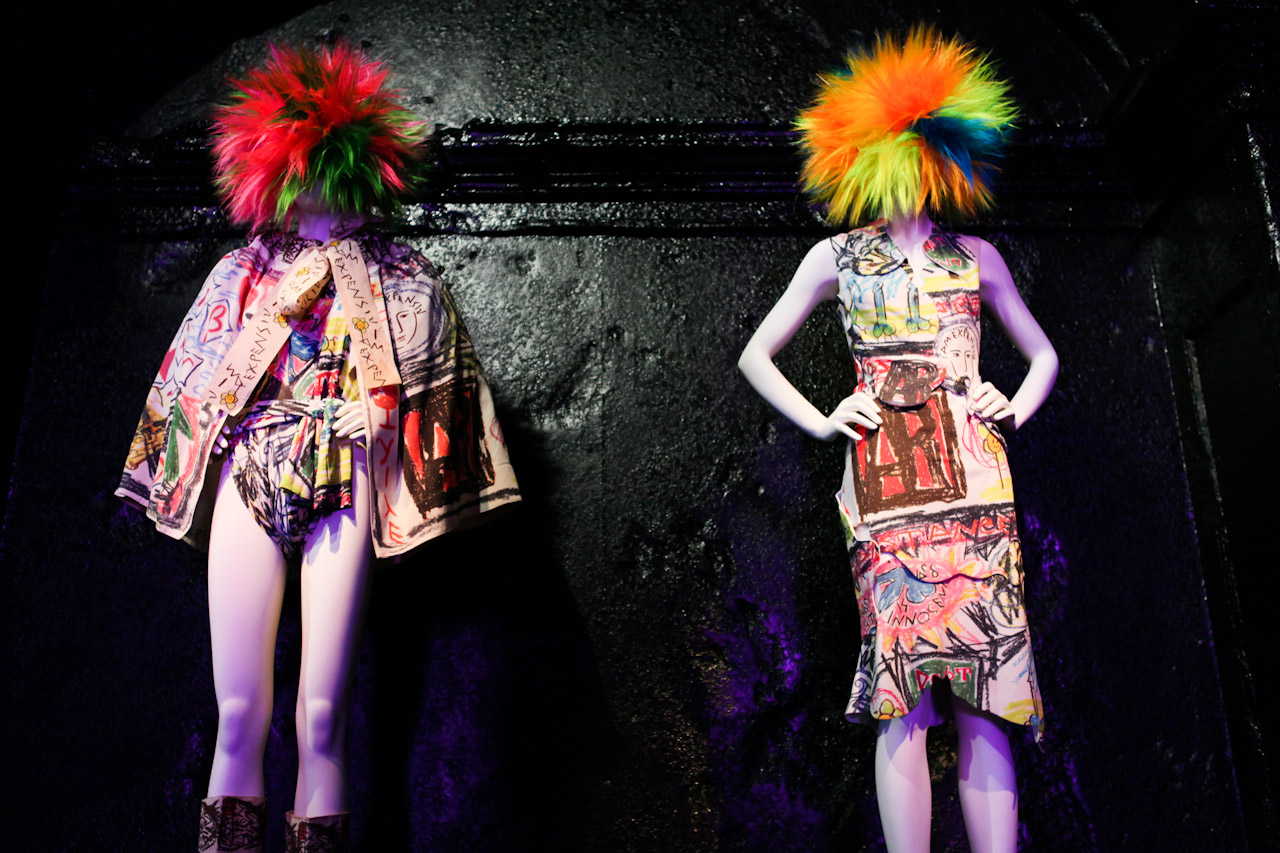
Mannequin wearing Guido Palau's rainbow colored headpieces, handmade
 - along with 100 other rebel-chic helmuts - for the Met Exhibition. Photos: models.com
“Punk, like fashion, has always felt a bit like a competitive sport. No matter how outrageous or offensive or grotesque or radical you or your friends thought you were being, with your torn or splattered whatever, your shaved or spiked something or other, there was always someone more shocking, more mesmerizingly weird than you. There was always that one person who was more committed.” 


The Met Gala is the perfect example of my theme for the next two months, Fashion is Theater. The Met Gala began in 1948, and was originally conceived by Dorothy Shaver and Eleanor Lambert as a way of adding to the Costume Institute’s endowment and was primarily an industry event. Now, ‘The Party of the Year’ not only includes the fashion insiders, but celebrities make the glamour of the night that much more entertaining. An increasing number of notable athletes have even become prevalent at the Gala as well, which is another indication of how much fashion has touched all walks of life. It is a dramatic ceremony of the Institute’s grand opening of the Costume Institute’s spring exhibition; but, the drama that is associated with the Met Gala, and the Costume Institute’s mission to raise awareness of dress in human history did not become synonymous until 1973 when a certain fashion arbiter became the Institute's Special Consultant. Diana Vreeland was that catalyst for bringing life to the Institute, and to the field of costume curating as a whole. She was the embodiment of ‘Fashion as Theater’


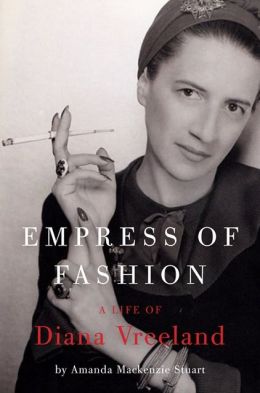
I spent a lot of time over the past few months reading up on Diana Vreeland. I read ‘The Empress of Fashion’ by Amanda Mackenzie Stuart, ‘Diana Vreeland: The Eye has to Travel’ by Lisa Immordino Vreeland, and ‘Diana Vreeland’ by Eleanor Dwight. I really wanted to become very familiar with Diana Vreeland before I spent time on #IMFblog to highlight her as a Style Maven. Diana Vreeland’s work in fashion, and passion for life was inspiring to read about because her influence played a large part in the creation of the modern fashion industry. Diana Vreeland, born September 29, 1903, had a privileged childhood growing up amid the fashionable of New York’s Upper East Side, moving to Europe as a newlywed with her lifelong husband where she learned European luxuries and etiquette, developing her own striking style and reputation in fashion. When World War II forced her back to the states, she joined the staff of Harper’s Bazaar as a fashion editor under Editor-in-Chief, Carmel Snow, in 1936. After more than 25 years, in 1962, Diana Vreeland made the move to become Vogue’s next Editor-in-Chief, bringing a new energy and life not only to the magazine, but to fashion as a whole. With Vogue as her platform, Vreeland’s flair and ingénue personality led women in dressing during a time when women finally felt free to look as inventive and sexy as possible. After rearing countless models, photographers, writers, editors, and movie stars, to successful careers by highlighting the zeitgeist of the 60s in Vogue, her reign at the helm ended in 1971, and she took on the challenge of curating at the Metropolitan Museum of Art Costume Institute in 1972. She oversaw the creations of fifteen exhibitions (Here later shows, "Man... for the Institute until the autumn of 1989 when she passed way. Diana Vreeland’s enchanting view of the beauty of life is something that carried her through life as she grew up alongside the development of the modern fashion industry. 

André Leon Talley working with Diana Vreeland for the Metropolitan Museum of Art Costume Institute in 1974.
My quest on #IMFblog has been to examine where trends and social behavior originated as it pertains to fashion and style. I aim to find what fashion was, and what we are turning it into day by day going forward. Diana Vreeland having served as Vogue’s Editor-in-Chief at a time when fashion became a powerful tool of expression for women helped her to convey to America a concept of beauty that was aspirational and liberating for all women to follow. Diana Vreeland’s aura is still riddled in the excitement associated with the fashion industry, and the way that we think about fashion is a product of the mind of this visionary figure. That is why this month and next month I choose to delve into her work at the Costume Institute which is another arena of fashion where she brought her inimitable influence setting a standard that we still aim to achieve not just for fashion, but in the field of costume curating. I want to examine what we can learn from DV about style and fashion through her curatorial work. I figure, in light of this year’s exhibition opening, doing so will give us an eye into the difficulty of producing an exhibition, and Vreeland’s thoughts on how to create drama in presentation. In my fashion, one who has style has a recognizable character, and those who understand the character they play in life have the power to produce a life’s story that teaches others what it means to live a fulfilling life.

Remember, "Fashion IS theater!"
Diana would mastermind twelve exhibitions - one a year, beginning with her Balenciaga show, which opened in the winter of 1973, and ending with the 1983-1984 exhibition on the career of Yves Saint Laurent. Several later shows, "Man and the Horse," "Costumes of Royal India" and "Dance," contained her ideas, but were organized when she was not well enough to come to the museum. 

Diana and Met designer Stuart Silver in her red lacquer office. Photos: Diana Vreeland by Eleanor Dwight

The subjects of the exhibitions were rich and varied. Tom Hoving found that her ideas were so good that she only needed to mention a possible subject to him and he would quickly approve it. Her exhibition themes ranged from the careers of particular designers such as Balenciaga and Yves Saint Laurent in separate shows, to groups of designers like Chanel, Schiaparelli and the others covered in "The Tens, Twenties, the Thirties: Inventive Paris Clothes 1909-1939." She also staged exhibits developed around a central idea, such as "Romantic and Glamorous Hollywood Design" or the costumes of different countries or empires ("The Glory of Russian Costume" or "The Fashions of the Hapsburg Era - Austria-Hungary"). Different personalities were highlighted in "American Women of Style" and  "The Eighteenth-Century Women." Some exhibitions, like the Russian and Hapsburg exhibits, arrived from out-of-house pretty much complete, while others were entirely worked up by Vreeland and her staff, borrowing from many sources, both costume collections and private wardrobes. Her greatest contributions were the exhibitions like the Russian show, which showcased clothes that were not only unfamiliar, but were also breathtakingly beautiful and of great historical interest.     


Her displays, which often included as many as one hundred mannequins, would appeal to the imagination and plunge the viewer into a milieu - perhaps a celebration of a great moment in Hollywood, or her version of the eighteenth century. She wanted the clothes to appear fashionable to the contemporary viewer. As Susan Train remembers, "These shows were not history - they were fashion. They were people wearing beautiful clothes." The viewer might see a mannequin representing Grace Kelly in a movie gown, a figure of pop star Cher, or Garbo as Queen Christina. Figures wearing the garments of Peter the Great and Catherine the Great of Russia, the children of the Hapsburg court, all would appear in impressive groupings in the basement of the Met. As she had done in her magazine pages, Diana Vreeland would give the viewer something more.  - From Diana Vreeland by Eleanor Dwight  

Monday, May 27, 2013

Style Watch: Fashion is Theater

In my fashion, having style is about having a particular point of view of life, and knowing how to reflect that view when people look at you. These three videos that caught my attention this month were from women who definitely have something to say about who they are, and what they stand for. Each of these videos project a certain vibe, and certain look that is attainable, meaningful, and inspirational no matter what your background is. Here's some video's for you to watch and listen to on this Memorial Day Weekend, and take away some style hints. 


Janelle Monae became one of my favorite artists in 2008 when she came out with her single Many Moons from her album, Metropolis: Suite I (The Chase). I have heard her compared to a women-Andre 3000 (and we know how I feel about Three Stacks), and I can concur with that comparison.  Her quirky, tuxedo style has made her very recognizable these past years since she came out with 'Many Moons', especially as she adds 'Cover Girl' to her resume. I was very proud of her when I saw this video, Q.U.E.E.N., because in my fashion, this video is well suited for a wide audience for it's fun, simple, bouncy, and fresh. The video has an enormous amount of style, and is indicative of what type of girl she is with the 60's funk sound, monochromatic color scheme, and upbeat energy. She says, "Even if it makes other uncomfortable, I will love who I am." She just wants to be free to be, and all the dancing in the video is bound to set any viewer free because her energy is infectious. Erykah Badu, was a perfect touch for the video as she is one person who has stayed consistent to what she represents. 


This video has a bit more of an aggressive, hard vibe, but is so poetic, not just because of this artist's lyrics, but I was enchanted by the snake-like allure of this Miami Cuban's exotic sultriness as she raps. Her name is Kat Dahlia, and her sultriness is offset by the story she tells in her debut single, Gangsta. This song grabs me like a snake charmer hooks a snake to its tune. In my fashion, based off the experiences she raps about, she gives a new meaning to what we consider a "gangsta". I think she speaks for those girls who don't have the best influences in life, but she shows how even someone as pretty as she is surviving through it all. I love her sleek tops and bottoms, and heavy jewelry looking very Miami sexy, with her long shiny hair. Her skin tone seems to go with any color she wears, and she wears them boldly, just how they should be worn. According to Dahlia, this bombshell has learned some things in life, and she wants to share. 


I have always adored Selena Gomez! As old as I am, I would flip through the channels on TV, and I admit I use to stop on the Disney channel just because I would catch a glimpse of her play the spunky bohemian, Alex Russo, on Wizards of Waverly Place. In my fashion, while Selena was playing a character on the show, I felt that the 'edgy-girlie' style she rocked on the show was more than just role play. Selena's style was infectious to watch because her baby doll features are something we haven't seen for a while in entertainment. Now, with her transitioning from the show to her new role as an pop star, her girl-to-women transition is looking good in this video for her single, Come and Get It. Instead of disappearing and concocting potions on her Disney show, in the video she is majestic in a much more mature sense with her sheer, flowy dresses making her look much more spiritual and ethereal with the kaleidoscopic imagery of her Bollywood inspired dances. The eye contact she commands when she looks at us is most indicative of her transition, because as we all know the eye is the window to the soul, and in my fashion, her soul is saying she is coming of age so, "Come and get it!" Selena has been doing a good job communicating this to the world since the single's release as I have seen her on so many award show platforms. From her debut performance in April at the MTV Movie Awards, she has been promoting her song like a pop star should be, up to her most recent performance, May 19th, at the Billboard Awards. Her performances have provided her a smooth entrance into her new role, and  is perfect marketing for her, because she's been on Billboard Top 100 for the past six weeks (currently number seven)!

Wednesday, May 1, 2013

EDITOR'S LETTER: May 2013

My look on the way to Rihanna's Diamond tour in
DC. As you can see my intention was to be seen!
In my fashion, now a days, you are your own model. While fashion has always been about portraying your best self, in this digital era, not only can people show off to a world wide audience with social media, people have the power to market themselves just as good as any modeling agency could. Social media allows us to highlight our talents in more ways than one, and if you are creative enough, opportunities present themselves with each view of one’s profile, each “like” to one's photo, and each follower one obtains. Social media gives all of us the opportunity to do as Diana Vreeland said, which is to “be ingenious and make ourselves into something else." A new wave of sartorial expression via blogs and sites like Twitter, Facebook, and Instagram has created the possibility to become our own models/entertainers in our own rights and connect with others who enjoy what we can do. We create photo albums on Facebook; Twitter and Instagram have quickly gained momentum as popular social mediums; and the authority of bloggers is continually on the increase. If you took a look at my last two READing Your Style posts (Part 1 and Part 2), the way we experience and interpret fashion changes with each generation, and in my fashion, I find it fascinating how digital media is this generations motivation for having fun with fashion.

This month is the Metropolitian Museum of Art Costume Institute's opening of it's exhibition "Punk: Chaos to Couture" (May 9 through August 14). I thought a good way to celebrate this month would be to take a look at the past exhibitions curated by the legendary Diana Vreeland. I choose to look at these exhibitions because as dress historian, Valerie Cumming, says in her book 'Understanding Fashion History', "Diana Vreeland reinvented costume exhibitions as glossy extravaganzas, fashionable social occasions and introduced the concept of hagiography of living designers. After her death in 1989 there were no more special consultants at the Costume Institute, but she had set a pattern that is still being followed: glamour, erratic scholarship and maximum celebrity appeal. It is a heady mix - fashion as spectacular theater - and its impact has permeated well beyond America." This being so, I wanted to take a look at the 15 exhibitions Vreeland curated and discuss their significance. What perfect way to celebrate this years opening on #IMFblog.

Attitude.
Diana Vreeland lived under the impression that fashion is theater, and in my fashion I tend to agree. Fashion is more than simply wearing the latest designs and being first to wear something outrageous - fashion is all about attitude! A few days ago I attended Rihanna's 'Diamonds' tour. The venue was packed with girls in little skirts and leather, but the pieces that stood out, in my fashion, was anyone wearing neon, and girls wearing colorful fur bolero jackets like the one Rihanna was spotted wearing in Paris last December. I was so energized by the daring ensembles I saw, for I know the amount of attitude and conviction it takes to be explicit in expressing your style. This month will be a month dedicated to how the joy of fashion comes from the theatrics accompanied with a particular look. Having style is about portraying a character, and to pull off a look, one must understand that a bit of dramatization in one's dress is what shows your commitment to being who you are. Like the early generation of punk rockers who strove to dramatize their alienation through their garb to make the statements they felt weren't being heard, the more effort you put into creating a radical look, make you that more intriguing to be heard. In my fashion, fashion is about finding what makes you so intriguing.