Sunday, August 4, 2013

EDITOR'S LETTER: August 2013

Think about why two women can wear the
same dress and rock them differently? Look
at their poise, grace, and posture!
I am a firm believer in the idea that, to understand where one is going in life, one must have an understanding of one's past. What is it in our past that made us into what we are in the present? In my fashion, it would only make sense that a certain understanding of fashion history is what makes the difference between a "clothing-horse" and a fashion advocate with a real sense of personal style. If I am wrong, if anything, one can certainly tell that an understanding and knowledge of fashion history, in some way, subliminally enhances ones style. Style is all about poise, grace, and posture, and when one finds a piece of fashion history that really speaks to us on deeper level, it is reflected in our poise, grace, and posture, because that bit of knowledge that resonates within us gives us the confidence to be who we want to be.

In my fashion, one’s understanding of fashion's past helps to enhance the appeal and authenticity of ones style because I believe when it comes to fashion and having style, every visible detail means something and says something about how we live our lives. Every detail from the yellow hair tie a girl pulls her hair up with, to even one's hand movements tell a story of where we have been in our lives. I was always fascinated with the Sherlock Holmes stories when I was younger because of his deductive reasoning. He could deduce what happened at a crime scene by paying attention to details and connecting those details in a way that reveals the truth. In this exaggerated example of our deductive abilities as humans, in my fashion, examining other people's fashions works the same. 

Style is all in the detail. 
This month lets think of Sherlock Holmes as we motion to gather more knowledge of fashion by examining Tim Gunn's Fashion Bible. Sherlock Holmes was able to make such intricate conclusions and come to understandings that no one else could fathom because he had a vast storage of knowledge of how the world works, and what has happened in the past. Tim Gunn's book helps us to become Sherlock Holmes of fashion. Understanding the original meaning of clothing items helps us to compare what the garment was intended for, as opposed to why an individual is wearing it today in our time. Looking at other's clothes we can deduce a person’s personality, interests, and viewpoints on life. In my fashion, the less that we are able to express our personality through our clothes the weaker our style, and as Diana Vreeland says, "Without style you are nobody!" As I have observed, people tend to respect other people with style! It’s important to express ourselves through our clothes for visuals constitutes 55% of communication between people, and you should know how to express the best of yourself through your sartorial journey and maturity through life. 

Of course this month we are going to keep with the best of fashion, which is The Secret World of Couture. In my fashion, the special idea behind a couture piece is that it has the ability to plainly communicate the extraordinary qualities of an individual and is indicative of one's amount of imagination and free will. One has to have quite a free mentally to express ones imagination through their clothing. As I heard artist and socialite, Daphne Guinness says, what’s interesting about fashion is the idea that we can transform ourselves because we are human beings and we can. Haute couture is much more than just finding the most elaborate and extravagant dress from the couture collections. It’s about finding the right fit to a dress made for none other than yourself and for your personality. Couture is an emphasis, and appreciation, for detail; style is an emphasis on point of view, so when you put them together, one creates a look that is alluringly unique. As is the theme of these two months, Unique Is Chic, fashion allows for the celebration of our uniqueness. In my fashion, thank God we are not all the same - how boring would that be?

Saturday, July 27, 2013

READing Your Style: How to be Devastating

Donatella Versace
Have you ever been in a store, searching for a look for an event, meeting or date, but you have no idea what you want to look like? I hate that feeling. That’s why I was thoroughly pleased to find Donatella Versace’s 5 Style Lessons on how to be devastating in InStyle’s March 2013 issue. Donatella Versace is the Vice President of the Versace Group, and head designer of the highly popular and sexy couture label, Versace. Just like Donatella, the Versace girl is fearless, dynamic, unmistakable, and unforgettable. In my fashion, these qualities would be qualities any women would want to have in this world, no matter what their personality type or penchant for tight fitting, skin revealing clothing. Next time you are in the store, and you just can’t seem to find a piece that jumps out at you and screams, “WEAR ME,” these lessons should help one to narrow down what items to buy to exude that confident effervescence we attempt to attain in all of our looks, no matter how haute we choose to look. Below you will see photos from the Fall 2013 Couture Show shown earlier this month, photos courtesy of New York Magazine.


1. Show a little skin: When the economy crashed in 2008, everyone tried to make safe clothes with familiar silhouettes in classic colors, but that approach doesn't really pay off. Women deserve distinction and originality, and there are fresher ways to look womanly than exposing a lot of cleavage. I find clothes that feature transparency alluring, like my silk satin dress with a gold-net hemline that hints at the body underneath. 


2. Rely on what feels special: Looking safe is never chic. It's ordinary. Instead, you owe it to yourself to discover what allows you to be yourself, whether it's indulging in a leather bag that speaks to you, or playing up - rather than hiding - what others deem a flaw. Done skillfully and with a positive attitude, highlighting the very thing that sets you apart from others is what will make you striking and unique. 


3. Find silhouettes that celebrate your body: I have never met a woman, no matter how beautiful, who isn't insecure about her body, so my designs are body conscious in ways that complement female curves. What matters first is to use fabrics and proportions that make a woman feel secure and noticed. I love lightweight wool crepe, shiny jersey, and satin, all of which let you cut clothes close to the body without clinging. Jersey is so forgiving - and it's the easiest material to wear. 


4. Accentuate your waist. Seriously! I like to show it off because it's the key to defining your shape. Make the shoulders wider and your waist appears narrower. Raise the mid-line a little and your hips look longer. Revealing instead of hiding your waist will always work to your advantage. 


5. Embrace your age: I am not an ageist. And at least from the back, most women look alike. But from the front, you must accept reality. Sophistication is maturity's most appealing accessory. You can stick to miniskirts if you adore them, but add tights or stockings. On the one hand, it's fun to throw it all together and be adventurous when you're young, but in the other hand, youth would look a lot better with a touch more glamour and less flash. 

Saturday, July 20, 2013

Style Watch: Vogue Voices - Alexander Wang

My theme this month, “Unique is Chic” is inspired by the fact that, in my fashion, fashion is all about understanding what it is that makes us stand out from others, and how we can present that uniqueness to others. Recently, I was able to watch Diana Vreeland’s documentary, “The Eye has to Travel”, and what she emphasized in fashion is how to make an asset of one’s faults. If one has a space in one’s teeth, make it the most beautiful thing about them; If one is tall, become taller by wearing high heeled shoes; If one has a long neck, be proud of it and don’t hunch over; if one has got a long nose, hold it up and make it your trademark. Fashion designers have an amazing ability and talent to create clothes that help us to push our faults in the most glorious ways, because after all, our faults are what make us unique, and why should we be ashamed of what makes us whole. Vogue has a new video series on Vogue.com entitled, “Vogue Voices”, which delves into the minds of some of the biggest designers of the moment and what makes them qualified to run a design house. Couture is all about the unique and one of a kind, and being that this month on #IMGblog is all about “The Secret World of Couture”, I decided to bring the interviews of the couture designers from this series to my Style Watch series. In W Magazine’s May 2013 feature, “The Man Who Loves Women”, Alber Elbaz, Creative Director of Lanvin, made an interesting assertion he learned from co-founder of the couture house, Yves St. Laurent, Pierre Bergé: “The best business people are the ones who think like artists. And the best artists are the true business people.” Making women beautiful is a difficult business and the designers of couture houses take their business very seriously, and are very wise about life and how to create products that work for women’s lives. This month I wanted to see what specifically we could learn about fashion from these designers for I always find it interesting how much wisdom can be gained from the eccentric minds of fashion designers.


Alexander Wang believes that fashion is a melting pot, and that it is changing all the time. To him, the people in fashion are just crazy enough to go along with the ride because they love it so much. In my fashion, I agree because the one commonality that I feel between anyone who is interested in fashion, is that we are all fascinated with elevating the everyday. What I enjoy most about Wang’s designs is that we see this elevation of the everyday so clearly, yet the basic premise and purpose for the piece is not lost behind the design. The fact that Wang bases his pieces on the basic concept of sports ware and creating pieces that a have a sense of ease that people can relate to in their busy lives, is what is so appealing about his self titled brand. With his wearable, abstract, and highly modern pieces, the exhilarating growth that his brand has made since 2005 is why he was approached by Balenciaga three months ago to become the house’s new Creative Director after, Nicolas Ghesquière

Fox jacket, silk velvet pants, and calfshin
sandals from Wang's 1st collection for
Balenciaga. (Photos: Vogue)
In Wang’s debut collection for the house, it is said in the June 2013 issue of Vogue, that “it was an impressive and focused beginning,--an elegant, respectful homage to the house’s legendary founder. There were jackets and coats cut with curving, air-injected shoulder lines and fastened with gleaming silver claps; narrow trousers or long, lean skirts, all in deep forest green or black; and a series of sleeveless hourglass coats and sheath dresses, embroidered to resemble the striations of marble, an effect echoed in the intarsia technique used for sheared-mink jackets atop silk-velvet pants treated to resemble guipure lace.” Wang says, “I felt it was important to go back to the roots of the house to reinforce Cristobal’s codes, but in the context of a modern, functioning wardrobe.”

In my fashion, what we see in Wang’s designs IS that elevation of the everyday, and the innovation he employs in his pieces are so attractive because he is aware of the fact that everyone’s lives are so complex, and the clothes that favor in today's market are clothes that are functional. He is most proud of the fact that there is such a range in the diversity of his customers, because he is most about his brand having a certain sensibility and attitude as opposed to catering to a particular age group and cultural background. The fact that his brand accomplishes this is an aspect that certainly qualifies him for his new position because, in my fashion, that is a principal aspect of couture that distinguishes it from the ready-to-wear. He sees that now a days it is good to see that brands are now beginning to pair customers with an aesthetic instead of pairing them to a price, which is more a way of keeping people from options, which is not the objective of designers.

The embroidery on sheath dresses was
made to look like marble. 
In my fashion, the one thing I favor most about what we can take away from Alexander Wang is that fashion brands are about telling a story, and building a connection with an audience based off that story. This notion is not true of just fashion brands, but it extends to other industries, and most of all, in society in general. Throughout history clothes have been used to single our success in life, and life is all about attracting other's to one's success to be with the people that want to continue a story of life with you in it. On top of Alexander Wang's genius of how to work fabric in interesting ways, his dedication towards understanding how people can communicate a certain story about oneself through their clothes is what, in my fashion, puts him on a level of couture sensibility. 

Tuesday, July 9, 2013

Style Watch: Vogue Voices - Alber Elbaz

My theme this month, “Unique is Chic” is inspired by the fact that, in my fashion, fashion is all about understanding what it is that makes us stand out from others, and how we can present that uniqueness to others. Recently, I was able to watch Diana Vreeland’s documentary, “The Eye has to Travel”, and what she emphasized in fashion is how to make an asset of one’s faults. If one has a space in one’s teeth, make it the most beautiful thing about them; If one is tall, become taller by wearing high heeled shoes; If one has a long neck, be proud of it and don’t hunch over; if one has got a long nose, hold it up and make it your trademark. Fashion designers have an amazing ability and talent to create clothes that help us to push our faults in the most glorious ways, because after all, our faults are what make us unique, and why should we be ashamed of what makes us whole. Vogue has a new video series on Vogue.com entitled, “Vogue Voices”, which delves into the minds of some of the biggest designers of the moment and what makes them qualified to run a design house. Couture is all about the unique and one of a kind, and being that this month on #IMGblog is all about “The Secret World of Couture”, I decided to bring the interviews of the couture designers from this series to my Style Watch series. In W Magazine’s May 2013 feature, “The Man Who Loves Women”, Alber Elbaz, Creative Director of Lanvin, made an interesting assertion he learned from co-founder of the couture house, Yves St. LaurentPierre Bergé“The best business people are the ones who think like artists. And the best artists are the true business people.” Making women beautiful is a difficult business and the designers of couture houses take their business very seriously, and are very wise about life and how to create products that work for women’s lives. This month I wanted to see what specifically we could learn about fashion from these designers for I always find it interesting how much wisdom can be gained from the eccentric minds of fashion designers.


Creative Director of Lanvin, Alber Elbaz, believes that real haute couture is when you actually work with a person. His favorite part of being a designer is being in the store, in the dressing rooms with a women during a fitting. He says that when he is fitting a customer, he gets so anxious with excitement that while they are dressing he will barge into their dressing area because he loves to work and feel that he can make a change. He compares designing to being a doctor in that he is very careful and attentive to the needs of his clients, and he loves finding the pieces that will “fit” her. For him the couture process is all about knowing the person, and understanding who she is, what she wants to hide, what she loves about herself,  where she coming from, and where she is going.


Elbaz specializes in creating clothes for beautiful, talented, gorgeous, women and he tries to help them look beautiful on the red carpet. For him, its more about how they feel than how they look. He tries to think of how to make the dress disappear, where one can look at the women, understand who they are, and in the end, we don’t see the dress on the woman, but we see the woman inside the dress. He doesn’t want the onlooker to be caught up in the styling because then one misses the point of dressing, which is to be seen for what you are. The dress is meant to enhance a women’s beauty, not be the focal point. He respects women for the work they have done, and the hard work they go through in their lives. He appreciates that fagility and vulnerability women posess.

Elbaz's illustration for the promotion of 
Lancôme Mascara.
Recently, Elbaz has been working with Lancome to design the packaging for their mascara line. In his W Magazine feature, he admits that he “adores women, and the one thing [he] wants to do more than anything is to see a transformation of personality when someone puts on one of [his] dresses.” His original agenda as a designer has always been to communicate with women through clothes, and he feels an obligation to the Lanvin brand and the Lanvin woman even though he has worked at other design houses such as YSL, Krizia, and was sought after for Givenchy and Dior. Elber is committed to the idea that his clothes be timeless and in a way, helpful: He wants to make it easier for women to dress for their complicated lives. He says, “I am not interested in perfection, and neither are the women who wear my clothes.” He also says, “I don’t ever use the word ‘sexy. My clothes may be sexy, but I am more interested in what is beautiful—and that has nothing to do with age or size. Or…sexy. I don’t even know what that word means.”

The philosophy of his work is to do things in a different way, and to bring joy to his life. “When you enjoy something and bring a good energy to it, it shows in the product.” He says, “Basically we create what we are: when we are sad, we create sadness; when we are happy, we create happy, when we are miserable, we create misery, and it shows through the product, and is felt on the body.”

Monday, July 1, 2013

EDITOR'S LETTER: July 2013


 In my fashion, Haute Couture is the ultimate
appreciation of clothes.
I have been absolutely intrigued by how fascinating fashion can be when one really delves into its history. In my fashion, having knowledge of fashion history empowers personal style. If you have been following #IMFblog for the past two months learning about Diana Vreeland’s accomplishments at the Costume Institute, hopefully you have gained a plethora of insight into how costume history has influenced our modern views of what we find beautiful. Through DV’s point of view, and her flare for presentation, she introduced new ways of thinking about the importance of fashion in a societal context through time. Her work mostly helped to bring inspiration and aspiration to the high fashion designers of the industry, and their work would go on to become revolutionary in their respective points in time. In these past months I have really began to ponder the reason why the Couture houses maintain their high standards, and how they run their business as the leaders of fashion ingenuity. I recently came across a BBC documentary which followed its reporter, Margy Kinmonth, as she met various members of “The Secret World of Couture” from the point of view of an outsider being allowed access to a heavily guarded insider club of sorts.

"Unique is Chic!"
While anyone can become a part of the couture festivities, one must have made their way up the social latter quite high before couture regulars will acknowledge your presence. I wondered why it is that people like Karl Lagerfeld, and Alber Elbaz, Riccardo Tisci, and most recently Alexander Wang are inspired to provide garments to the world of which a body may never feel the inside of. Clothes that are so special, they only need one outing to be burned into the mental images of those that see the woman in that dress (and these days with the internet, everyone is able to see the woman as soon as she steps out into the daylight). In my fashion, the couture shows are so magical just to see on live-streams. I can only imagine being present during these events (can you imagine the goose bumps). Watching the BBC documentary one gains an understanding of the level of the fashion industry that is responsible for bring fashion to the rest of the world through wildly imaginative and expensive pieces in the couture, down to the ready-to-wear collections and mainstream fashion.


"Life is an endless costume party!"
 This month I am inspired by the magic of “The Secret World of Couture”. Diana Vreeland adored Paris, and was alive during a time when designers of the great couture houses of today were making their beginnings for the fashion industry. She socialized and was friends with the designers Cristobol Balenciaga, Coco Chanel, Hubert Givenchy, and Christian Dior. So this month I am going to be looking into the point of views of the current couture design house heads, and how they help individuals assert the power of the imagination through clothes. One fashion expert whose book I have been reading of late speaks on the influence of these design houses, and much more on fashion history, in his book “Tim Gunn’s Fashion Bible”. Tim Gunn maintains that fashion is all about context—societal, cultural, historic, economic, and political. To him, dismissing fashion as silly or unimportant seems like a denial of history and frequently a show of sexism. I support this notion, and that is why I work to understand fashion in its entire context within our world. As feminist, Elizabeth Wilson postulated, “immense psychological and material work goes into the production of the social self, and clothes are an indispensable part of that production.” As Vogue says in its July 2013 issue, “Life is an endless costume party,” and when one thinks about it, the fashion industry is actually quite young, but inventive costume and adorning oneself has always been an innate aspect of the human experience. In July, we will delve into why, “Unique is Chic.” 

Sunday, June 30, 2013

Bit-O-Inspiro 40


As Shakespeare once said, "All the world's a stage and all the men and women merely players."

Saturday, June 29, 2013

Style Maven: Diana Vreeland and the Met (Part 10)

Diana Vreeland
As I said in Part 1 of this Style Maven series featuring Diana Vreeland, my quest on #IMFblog has been to examine where trends and social behavior originated as it pertains to fashion and style. I aim to find what fashion was, and what we are turning it into day by day going forward. Diana Vreeland having served as Vogue’s Editor-in-Chief at a time when fashion became a powerful tool of expression for women helped her to convey to America a concept of beauty that was aspirational and liberating for all women to follow. Diana Vreeland’s aura is still riddled in the excitement associated with the fashion industry, and the way that we think about fashion is a product of the mind of this visionary figure. That is why this month and next month I choose to delve into her work at the Costume Institute which is another arena of fashion where she brought her inimitable influence setting a standard that we still aim to achieve not just for fashion, but in the field of costume curating. I want to examine what we can learn from DV about style and fashion through her curatorial work. I figure, in light of this year’s exhibition opening, doing so will give us an eye into the difficulty of producing an exhibition, and Vreeland’s thoughts on how to create drama in presentation. In my fashion, one who has style has a recognizable character, and those who understand the character they play in life have the power to produce a life’s story that teaches others what it means to live a fulfilling life. (Photos and text come from the following books: ‘The Empress of Fashion’ by Amanda Mackenzie Stuart, ‘Diana Vreeland: The Eye has to Travel’ by Lisa Immordino Vreeland, and ‘Diana Vreeland’ by Eleanor Dwight)

Her real interest was in the woman who wanted to close the gap: the gap between the way she was and the way she was and the was she wanted to be. The question that interested Diana was: how do you do it? The answer according to Diana, did not lie in transforming or reinventing one’s persona in a forced and unnatural way. .Rather, it was about becoming the “best” version of oneself; and to do that one had to become one’s own editor, one’s own curator.

There was a private family funeral followed by a memorial at the Metropolitan Museum of Art on November 6, 1989…The obituarists’ memories tended to be short: Diana’s great wartime fashion success, notably the Popover and her support of Claire McCardell, received barely a mention. Neither did her predilection for low heels, flat footwear, bare legs, and her introduction of Capri sandals. Dazzled by her persona, by a view of her as the great 1960s editor of psychedelia and flower power, those summing up her achievements in fashion overlooked her ceaseless, and sometimes unpopular, efforts to bring pizzazz to American fashion from the 1930s onward; her support for the craftsmen and –women of the fashion industry; and her conviction that “the eye must travel.” They also overlooked her steady championing of clothes that reflected the new silhouette, the new line of the twentieth century; clothes that liberated the natural female body, whether they came from Chanel, Yves Saint Laurent, Claire McCardell, the Ballets Russes, the dance studio, or the office messenger.

Give ‘em what they never knew they wanted,” 
and “The most boring thing on earth
 is to be of the world of what you do.”
More subtle commentators rightly saw Diana as an extraordinary catalyst, as the Diaghilev of fashion…More recently Diana’s exhibitions, and the controversies that came to surround them, have been reevaluated. As John Ross of the Metropolitan Museum of Art remarked when she died, “Mrs. Vreeland was a genius for understanding…that society expressed itself visually, whether it was through fashion, whether it was through photography, whether it was through the way that people lived.” By introducing the idea that society expressed itself visually in a way that cut across dichotomies like young/old, working-class/aristocrat, feminist/non-feminist, and by placing this insight at the heart of costume display, Diana mounted a series of exhibitions that were undoubtedly radical…Her exhibitions always attempted to reflect the woman, the man, the style of life, the dreams behind the clothes. Even though Diana herself might have been uneasy about it, the exhibitions thus staked a claim for fashion as art: the art of the dressed body.

The exhibitions coincided with, and made a contribution to, the emergence in the early 1980s of the idea that the dressed body was a cultural phenomenon in its own right, to be studied by academics and argued over by cultural theorists, a result that would have astonished—and quite possibly appalled—Diana. The work of this new generation of fashion historians and fashion theorists allows us to see Diana in a different way: as a fascinating exemplar of a small group of women who wielded great power in the fashion industry as designers, photographers, journalists, and businesswomen from before the First World War. They were breadwinners, wives, and mothers, too, but they derived their social and economic power from a pre-feminist view of female identity. ..Contemporary theorists are also reexamining the idea that inspired Diana and so many of her contemporaries: of beauty and allure as empowering in themselves. They point out that it is an extremely powerful idea; that it is rooted in sexual attraction; that it has never gone away; and that it continues to jostle for space with more contemporary views of female identity. Moreover, it often jostles along with competing ideas of female identity in the same woman.

Diana was known to say, life had its up-and-down trips. “You must choose one,” she said. “The down trip makes for a bad liver, bad digestion and fewer friends. The up trip is naturally delicious and never ceasing. I believe in people who are on the up trip.”

One reason for this, perhaps, is that Diana’s greatest achievement is barely visible to the naked eye. It lies out of sight, in memory and dreams. “I don’t like to work,” she once said. “I only like to dream and achieve…quite a different matter.” …The rational mind was, she thought, too often prosaic, too often circumscribed by hesitation and fear…To Diana the imagination liberated the possible: with a little imagination something ever more “wonderful” was just around the corner and ever present in the here and now…What she did, indefatigably, and from a position of great influence at Vogue, was to assert the authority of the imagination—and the idea of possibility that galloped along beside it.

Thursday, June 27, 2013

Bit-O-Inspiro 39


When innovative academic work on fashion first emerged in the 1980s, the ground was broken by Elizabeth Wilson in a book called Adorned in Dreams. Although Wilson was a committed feminist, she challenged those who rejected fashion as trivial or symptomatic of false consciousness. Fashion, she suggested, has the power to mark out identity in a way that we should embrace rather than distrust. It even has the power to subvert. “Socially determines we may be, yet we consistently search for the crevices in culture that open to us moments of freedom,” she wrote. Fashion, she continued, acts as a vehicle for fantasy. “There will…never be a human world without fantasy, which expresses the unconscious unfulfillable. All art draws on unconscious fantasy; the performance that is fashion is one road from the inner to the outer world.” Immense psychological and material work goes into the production of the social self, and clothes are an indispensable part of that production. This is what makes it so compelling but causes us to react to fashion with ambivalence as well. - Found in 'Empress of Fashion: A Life of Diana Vreeland' by Amanda Mackenzie Stuart

Wednesday, June 26, 2013

Style Maven: Diana Vreeland and the Met (Part 9)

Diana Vreeland
As I said in Part 1 of this Style Maven series featuring Diana Vreeland, my quest on #IMFblog has been to examine where trends and social behavior originated as it pertains to fashion and style. I aim to find what fashion was, and what we are turning it into day by day going forward. Diana Vreeland having served as Vogue’s Editor-in-Chief at a time when fashion became a powerful tool of expression for women helped her to convey to America a concept of beauty that was aspirational and liberating for all women to follow. Diana Vreeland’s aura is still riddled in the excitement associated with the fashion industry, and the way that we think about fashion is a product of the mind of this visionary figure. That is why this month and next month I choose to delve into her work at the Costume Institute which is another arena of fashion where she brought her inimitable influence setting a standard that we still aim to achieve not just for fashion, but in the field of costume curating. I want to examine what we can learn from DV about style and fashion through her curatorial work. I figure, in light of this year’s exhibition opening, doing so will give us an eye into the difficulty of producing an exhibition, and Vreeland’s thoughts on how to create drama in presentation. In my fashion, one who has style has a recognizable character, and those who understand the character they play in life have the power to produce a life’s story that teaches others what it means to live a fulfilling life. (Photos and text come from the following books: ‘The Empress of Fashion’ by Amanda Mackenzie Stuart, ‘Diana Vreeland: The Eye has to Travel’ by Lisa Immordino Vreeland, and ‘Diana Vreeland’ by Eleanor Dwight)

The 18th Century Women
Exhibition Catalog
The Eighteenth-Century Women Exhibition (1981): The Mannequin head is not only the most visible part of the clothed mannequin, but also gives the curator a chance to style a silhouette, often an important unifying element of the exhibition. Vreeland used this opportunity to great effect. It was not about making the mannequin look like a historical figure (with wigs and painted make-up). It was instead about bringing the historic silhouette into the present—desirable to contemporary eyes. Painting minimalist hairlines in strong and importantly unnatural colors was one way of abstracting the mannequins’ heads—blurring the becomingly behind gauze was another. Wigs were used not used from hair, but instead curled pieces of paper. Once again giving the idea of a style in a modern way or she altered their proportions harnessing the wig as a quasi-prop. As in the case of the famous “Eighteenth Century Wig” created by then intern Harold Koda, recalls Vreeland’s directive. “You know the Eighteen Century is all about proportion. It’s the heel of the show to the ankle. It’s the wrist to the angle of the sleeve. It’s all about proportion. Now I need a wig and want it to be hard as concrete.” 
 
Jeff Daily, Chief Designer, recalls working for Vreeland on a vast Trompe L’oeil Chandelier. “When it was done, it looked like this huge, crystal chandelier was hanging there but there was nothing above it, so it was just something you saw from a distance and you could see the portrait from behind it, and everything else, so it worked.”
 
Left: Harold Koda redid this fantastic headdress (left) for the “Eighteenth-Century Women” exhibit several times until it suited Diana, who looked at the finished version with glee and pronounced, Mmmm, now she’s ready for the guillotine!” Right: If you look closely at the wing in this photo, you can see that it was made of curled pieces of paper rather than a wig.

La Belle Epoque
Exhibition Catalog
La Belle Époque Exhibition (1982): As Koda and Martin wrote later, Diana’s version of history was history of “the grandest memory, a sweep through the elegances of the court of Versailles, a promenade through the grand silhouettes and extravagant textures of the Belle Époque, and the colorful Russia of the Czars.” She like to express the mood of an era through oblique, impressionistic details: a bouquet of violets on a winter sleigh stood for czarist indulgence (a Russian grand duke once paved an avenue in St. Petersburg with violets to welcome his Italian mistress); Alice in Wonderland, holding a flamingo, implied the topsy-turvy world of the Belle Époque. This approach to the past was extremely popular with the public; and Diana’s early exhibitions were so innovative, and their atmospheric lighting, music, perfumes, and backdrops so dazzling, that objections were muted. Both The Eighteenth Century Women (1981-82) and La Belle Époque (1982-83) brought in well over 500,000 people. In the fall of 1982, Diana began to work with George Plimpton on her memoir. She herself came up with the title, DV—the initials that she scrawled in green ink at the bottom of each page of magazine copy in her days as editor at Harper’s Bazaar and Vogue, and later on the bottom of pages of exhibition details at the Costume Institute. D.V. became the version of Diana's life that persisted unchecked until Eleanor Dwight's 2002 biography, though Diana kept telling Plimpton that she was "terrible on facts"and that someone needed to check all the dates and times.

Plimpton later said that he really did not care whether any of it was true: the interesting thing was the way Mrs. Vreeland told it. And when it came the way Mrs. Vreeland told it, boring facts were not the point. "Did I tell you that Lindbergh flew over Brewster? It could have been someone else, but who cares--Fake it!" she said, "..There's only one thing in life, and that's the continual renewal of inspiration."

Cathleen McGuigan of Newsweek put it well when she said, “Don’t think of DV…as a book; it’s more like a lunch. A bit of soufflé, a glass of champagne, some green grapes—light, bubbly and slightly tart—all served up by an eccentric but inventive hostess.”

Yves Saint Laurent
Exhibition Catalog
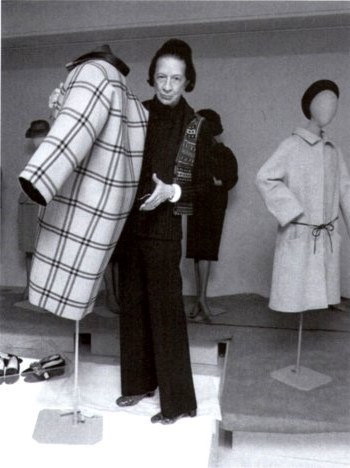
Yves Saint Laurent: 25 Years if Design (1983): Diana’s 1983 exhibition, Yves Saint Laurent: 25 Years of Design raised other eyebrows. This was the first time a living designer had been honored by the museum, and many people felt that this was nothing more than an elaborate public relations stunt that gave Saint Laurent an unfair competitive advantage, a feeling underscored by Diana’s rejection of chronology and anything close to a conventional retrospective. What she wanted to show in the exhibition was the inspired work of “the leader in all fashion today,” who had followed Chanel in understanding the new century and its changing way of life, and showed it how to dress. “This is an important point,” she wrote. “Both Chanel and Saint Laurent are equalizers. You and I could wear the same clothes; what we have on, anyone could wear.” To prepare, Diana went to Paris to see the Saint Laurent archives with her assistant Stephen Jamail. She examined the clothes from the different periods of Saint Laurent's career, which confirmed her notion that, in the words of Pierre Berge, M. Saint Laurent was a "genius in the are of fashions."

The Yves Saint Laurent show was unique because it honored a living couturier, one whom Diana had always admired. The brilliant designer from North Africa was first hired by Dior when he was only eighteen. Once he opened his own house in Paris, every collection he created was seen as dazzling.

At the Met she worked in the usual indirect way. She told Katell, "You know darling, Saint Laurent dresses the maids of France."Katell still wondered what she meant by the "maids of France." Finally Diana gave a hint: She's at the Louvre," and Katell guessed, "Joan of Arc! But what's Joan of Arc got to do with Saint Laurent,?" Because Saint Laurent put women in trousers. "Diana could not say, 'I think the woman who dresses as a modern woman in trousers embodies the idea of the free woman like Joan of Arc did.' It's a stretch, but it's an idea, and it's true that Joan of Arc in her trial was accused of being a sorcerer and a heretic because she wore men's attire. But Diana wasn't able to say that. She was able to say 'Go and find me the maid of France.' She was so visual that she could not tell you all her points because the verbal point has dissapeared. Only the image remans."

He was known as the “great adapter,” equally inspired by artists, writers and political movements. He put women into pants and used images from the street to inspire his designs.
The fact that Saint Laurent was alive presented problems for the exhibition designers. It meant that the show had to please him—when he came to New York, he objected to a fountain in the galleries, which was changed—and it had to withstand criticism for being an advertisement for the couture house. For the most part, however, it went off very well, because Saint Laurent realized what a privilege it was to be so honored and that everyone respected his genius.

Despite Diana’s great respect for her friend, it was ultimately her show. Now almost eighty, Diana spent weeks in Paris examining sketches and dresses with Yves and Pierre Berge. Berge remembered how she said, “’Pierre, it’s my exhibition, not yours. I mean, if you or Yves don’t like something, you tell me. If you’re right, I’m going to change it. If not, I will decide myself. It’s my exhibition.” I said, ‘Okay!’ And she was right.”

The exhibition displayed his great achievement. In true Vreeland style the clothes were not exhibited chronologically. The first room, which “vibrated with the same red beauty and intensity as the clothes,” housed his most famous creations. Another room showed his Matisse and Mondrian designs displayed flat on the walls. The third room showed just black clothes in all kinds of fabrics and designs. These was a green room with garden lattices, the “Chesnut Bois,” which showed his “day” clothes; and another room presenting dazzling embroidered and decorated jackets and, in the center, and circle of mannequins wearing clothes inspired by his African themes. There were 243 garments in all.


After 1984, she came to the museum less and less. Although she was still the special “consultant” by title, she depended on her staff to take over her many responsibilities…Several later shows (exhibition catalogs above), “Man and the Horse,” “Costumes of Royal India” and “Dance,” contained her ideas, but were organized when she was not well enough to come to the museum…On the basis of an unfair competitive advantage, many people’s unease towards the prominence given to Ralph Lauren’s sponsorship of the exhibition Man and Horse was comparable to the feelings felt for the Yves St. Laurent show…From 1985 Diana worked more from home and did everything more slowly. She continued to act as the public front of the exhibitions for the press, made contacts and opened doors, but Jamail, Le Bourhis, and Druesedow coordinated much of the installation while Diana animated and directed in the background…The ideas she floated for The Costumes of Royal India included using Andy Warhol’s elephant; talking to the British designer Zandra Rhodes, who had just come back from India; designing one of the backdrops as a page from an Indian miniature; and installing a water garden at the entrance: “Water, flowers, moonlight, to reflect moonlight would be wonderful…and good for the costumes.”…Diana was able to preside over one more exhibition, almost entirely from home. It was called Dance, and its theme was party clothes from the eighteenth century through to the sixties, the Twist, and the Peppermint Lounge...She managed a few more short press interviews, including one with Andre Leon Talley for British Vogue in December 1986: “Great dance dresses have a spirit of their own,” she told him. “They project allure into the wearer and into the evening. To dance is to experience a vitality and a lust for life that exists in each of us.”…Then Diana withdrew. It was a conscious decision. She finally called a halt to the grand performance, an end to being seen by others. Diana Vreeland died on August 2, 1989.